The full-size coach (Reisebus)
For a group of about 35 or more, the full-size coach is the usual choice: typically 49 to 57 seats and underfloor luggage holds. A licensed partner operator supplies it with a driver.
The legal side in brief
Carrying a group by coach comes under the Personenbeförderungsgesetz. Hiring a whole coach with a driver is an occasional service (Gelegenheitsverkehr), and the operator needs an authorisation for it. Behind the wheel is a driver with a category D licence plus the professional driver qualification (code 95 on the licence).
A tachograph records driving, breaks and rest. Passengers wear seat belts where fitted, though on a coach of this weight they may stand up briefly.
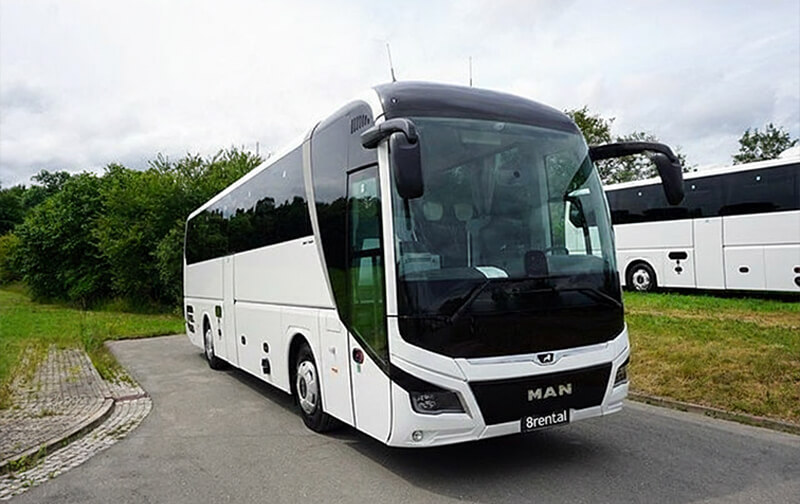
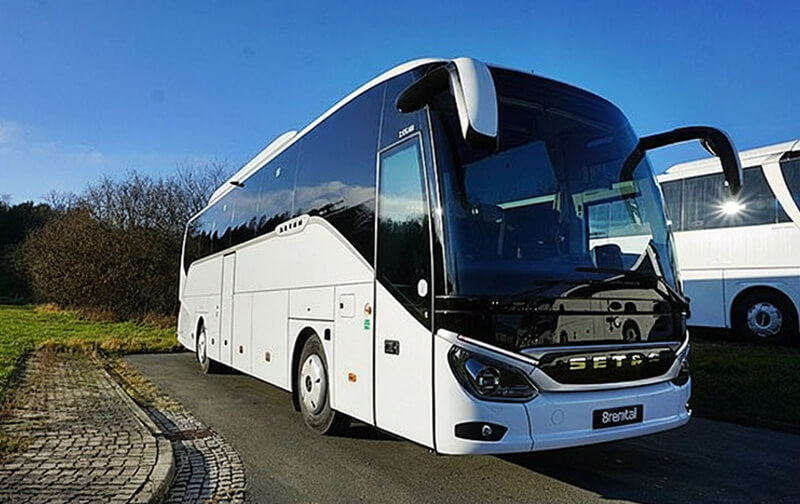
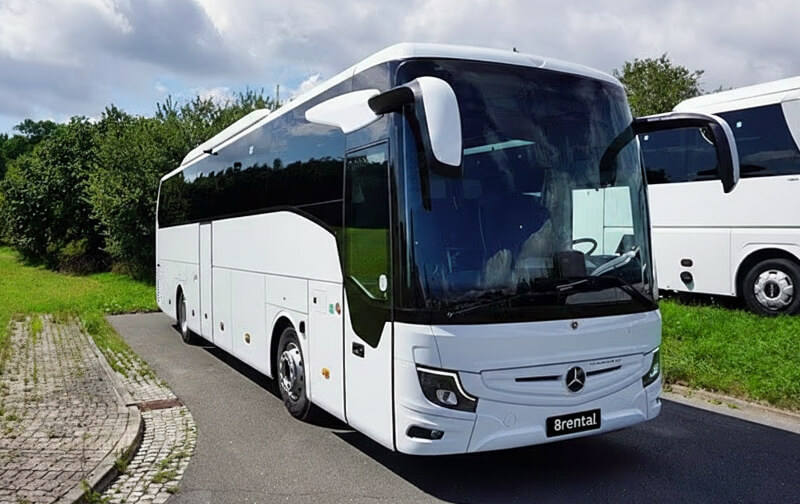
Seats and luggage
- Seats: 49-57
- Luggage: Underfloor luggage holds
Rules and equipment on board
- Carrying passengers for payment or as a business by bus in Germany comes under the Personenbeförderungsgesetz (PBefG); occasional services (Gelegenheitsverkehr) need an authorisation (Genehmigung)
- Occasional services include excursions (Ausflugsfahrten), holiday trips (Ferienziel-Reisen) and the hire of a whole bus with driver (Verkehr mit Mietomnibussen), in which the hirer sets the purpose, destination and course of the trip
- Under the PBefG, a bus (Kraftomnibus) is a vehicle built for more than nine people including the driver
- The driver holds a category D licence, for vehicles built to carry more than eight passengers besides the driver; professional drivers also need the driver qualification (Berufskraftfahrerqualifikation), shown as code 95 on the licence
- On motorways a coach may drive at up to 100 km/h only if it is approved for 100 km/h in its registration document, has coach seating, seat belts on all seats, a speed limiter set to no more than 100 km/h and no trailer, among the other conditions of StVO § 18 Abs. 5; otherwise the limit is 80 km/h, or 60 km/h with a trailer other than a luggage trailer or with standing passengers
- Required seat belts must be worn while driving; passengers in buses over 3.5 t may leave their seat briefly
- A tachograph records driving, breaks and rest on vehicles built for more than nine people including the driver
- Buses are exempt from the German HGV toll (Lkw-Maut) on motorways and federal roads, and the Sunday and holiday lorry ban does not apply to them
Motorway speed and tolls
The 100 km/h motorway limit applies to a coach only if its registration allows that speed, every seat has a belt, a limiter is set to no more than 100 km/h and there is no trailer. Otherwise the limit is 80 km/h. A coach is slower than a car, and drive times should say so.
Coaches pay no German HGV toll on motorways and federal roads, and the Sunday and holiday lorry ban does not cover them.
Where a full-size coach cannot go
Size matters in old towns. Coaches cannot enter the Nürnberg Altstadt or drop day visitors inside the walls of Rothenburg. München has no coach parking in the Altstadt. At Hohenschwangau, coaches use only P1 and P4. In Nürnberg, some railway underpasses are low, and the operator plans the route around the coach's height.
Questions organisers ask
When is a midi-coach the better choice?
With fewer than about 35 passengers, on narrow roads, or at small venues and hotel forecourts.
Can the coach cross into France?
Yes, for trips such as Strasbourg. The rules there are French: Strasbourg's zone needs a Crit'Air sticker, and the German sticker does not replace it.
What luggage fits?
The underfloor holds take the bulk of it. Mention skis, bikes, instruments or folded wheelchairs when you ask for a quote, so the operator can check the space.